

Robot Sales Export Acceptance: Preserve Identifier Text
2026-11-01
Robot Sales Export Acceptance: Preserve Identifier Text
A robot sales export opens successfully, but the receiving buyer notices that an identifier no longer looks like the source listing. The changed appearance may affect which item a later discussion refers to. Before accepting the export, ask whether the delivery preserves the identifier's characters and explains the field's meaning. This article follows an imaginary catalogue exchange and includes no genuine serial number or claim about ownership.
Decide which field identifies the offered item
Start by asking the contributor what the field represents. A listing reference, an internal stock code and a manufacturer serial identifier may all appear in one export. They need not identify the same thing. The buyer should not assume that whichever field looks most detailed is the authoritative link to the offered equipment.
Request an explanation of the agreed identifier and its association with the source record. The review can retain the supplied field label and the contributor's description without publishing sensitive records unnecessarily. If the association remains unclear, mark that question open. A well-formatted export should not turn an unexplained code into a verified asset identity.
If the destination assigns a new internal reference, ask how it remains associated with the contributor's identifier. Keeping both fields distinguishable can make later discussion clearer. The new reference should not silently replace the source convention in material intended for the seller.
Inspect the characters before treating them as a quantity
An identifier that contains digits is not automatically a quantity on which arithmetic makes sense. Ask whether leading characters, punctuation or letter case carry meaning in the contributor's scheme. This is an editorial field-definition question. The buyer should receive the applicable convention rather than infer it from a spreadsheet's default cell presentation.
The W3C tabular data model distinguishes a cell's original string representation from its semantic value. That distinction helps frame a review of a text identifier and a receiving tool's interpretation. It does not guarantee that a particular spreadsheet preserves every character or decide the right type for an undocumented commercial identifier.
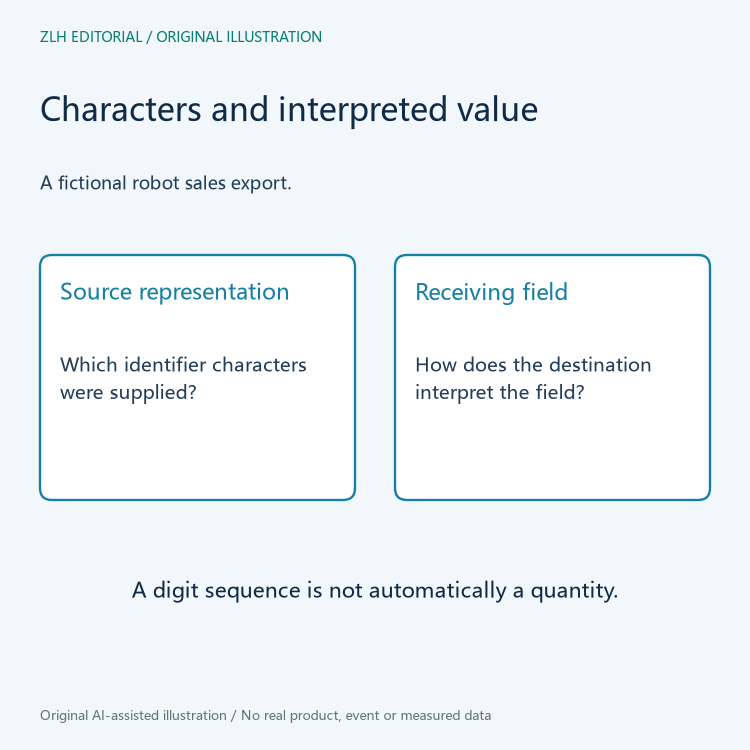
In the imaginary exchange, the reviewer sees a shorter displayed identifier after opening the export. Record the exact observation privately within the authorized review. The cause could involve formatting, interpretation or an earlier transformation. The reviewer should ask the contributor and receiving-tool owner to explain the difference before choosing a replacement value.
Read the receiving format's type rules
RFC 8259 defines JSON numbers with a grammar that does not allow leading zeros. JSON strings are a separate value type. This illustrates why transferring a lexical identifier as a number is a substantive representation choice, not merely a change in visual style.
Ask how the particular export and receiving schema represent the identifier. The right answer needs to follow the documented field convention. Do not automatically convert every numeric-looking field to text, since some fields genuinely express quantities. Equally, do not discard meaningful identifier characters just to satisfy a numeric destination that was chosen without review.
If the receiving system cannot express the required convention, request an agreed resolution before accepting the data flow. That might involve a documented field definition or a revised delivery format. The present article reports no conversion and proposes no commands for altering a live sales database. Its concern is whether the buyer can understand and retain the agreed identifier.
Check the association across a harmless review sample
The parties can plan a software-only review using non-sensitive demonstration records. Define what should remain associated between the supplied file and the receiving display. The observation should address both the retained characters and the correct record relationship. A matching-looking code alone does not establish that every associated field or asset description was imported correctly.
Preserve the source representation while investigating differences. Editing the original in place may remove the evidence needed to explain what happened. If the contributor supplies a correction, identify it as a new response and revisit the same field question. Do not retroactively describe an edited demonstration as proof that the original export was already correct.

Accept the data convention without claiming physical verification
A useful completion note identifies the field convention, the representations compared and the association actually reviewed. It can confirm that a sample export preserves the intended identifier while leaving broader completeness or physical-asset questions outside the conclusion. No actual serial identifier or transaction is verified by the conceptual example in this article.
The illustrations show text interpretation and a review route, with no real customer, seller or stock record. Related transaction-document topics appear in the robot buying and selling collection; the article directory provides further reading. A good export handover protects the meaning of an identifier rather than making a changed representation look authoritative through formatting alone.


